
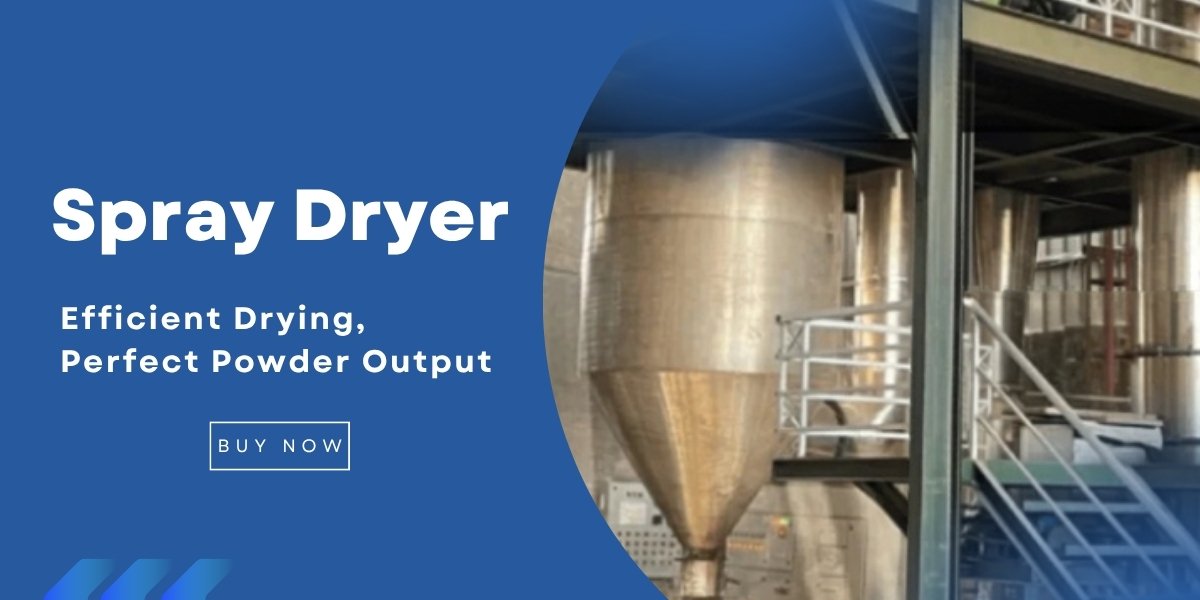
The Definitive Guide to Industrial Spray Drying Technology: Efficiency, Design, and Global Applications
In the modern manufacturing landscape, the ability to convert liquid feedstock into high-quality, consistent powder is a critical requirement for success. From the food we eat to the medicines we take, Spray Drying technology is the invisible force behind countless essential products.
As a premier Industrial Spray Dryer manufacturer, RK Engineering (Boilers India) has spent years perfecting thermal engineering to deliver systems that are not just machines, but high-efficiency production assets. This guide explores the “how” and “why” of spray drying and how to choose the right system for your facility.
1. What is Spray Drying? (The Science of Instant Dehydration)
Spray drying is a unique process where a liquid (solution, suspension, or slurry) is transformed into a dry powder in a single, continuous step. Unlike traditional drying methods that can take hours and damage the product, spray drying happens in milliseconds.
The Core Principle:
The magic lies in Surface Area. By atomizing liquid into millions of micro-droplets, the surface area increases exponentially. When these droplets hit hot air, the moisture evaporates instantly. Because of the “Latent Heat of Vaporization,” the core of the droplet stays cool, making it the safest method for heat-sensitive materials like milk, flavors, and vitamins.
As a premier Industrial Spray Dryer manufacturer, RK Engineering (Boilers India) has spent years perfecting thermal engineering to deliver systems that are not just machines, but high-efficiency production assets. This guide explores the “how” and “why” of spray drying and how to choose the right system for your facility.
Send Inquiry
Fill the form and our team will contact you shortly.
2. The Technical Anatomy of a Spray Dryer
A high-performance spray dryer from RK Engineering consists of several critical components, each engineered for precision:
Feed Pump System: Delivers the liquid at a constant pressure.
The Atomizer (The Heart): Converts liquid into a fine mist.
Air Disperser: Ensures the hot air mixes perfectly with the spray.
Drying Chamber: Where the actual moisture transfer happens.
Recovery System (Cyclones & Bag Filters): Separates the finished powder from the exhaust air.
3. Selecting the Right Atomizer for Your Product
One of the most common questions we get at our Ahmedabad facility is: “Which atomizer should I use?” The answer depends on your product’s viscosity and required particle size.
A. Rotary Disc Atomizers
Ideal for high-volume production and abrasive chemicals. They use centrifugal force to fling the liquid into droplets. These are robust and handle fluctuations in feed rate exceptionally well.
B. Two-Fluid Nozzle Atomization
Commonly used in Pharmaceutical Spray Dryers. These use compressed air to shear the liquid, allowing for ultra-fine control over particle size, essential for medicines and inhalable powders.
C. Pressure Nozzles
Best for producing coarser, free-flowing granules. They are energy-efficient and widely used in the food and ceramic industries.
4. Why Material Choice Matters (SS 304 vs SS 316)
In industrial drying, the “Skin” of the machine is as important as its brain. RK Engineering utilizes premium Metallurgy:
Stainless Steel 304: Perfect for general industrial and chemical applications.
Stainless Steel 316/316L: Required for Food-Grade and Pharmaceutical applications due to its superior corrosion resistance and hygiene standards (GMP).
5. Industrial Applications: A Versatile Solution
Our spray drying systems serve a diverse range of global sectors:
| Industry | Applications | Why Spray Drying? |
| Food & Dairy | Milk powder, instant coffee, fruit extracts. | Preserves taste, color, and nutritional value. |
| Pharmaceutical | Antibiotics, vaccines, encapsulated vitamins. | Ensures precise dosage and high bioavailability. |
| Chemical | Detergents, dyes, pigments, catalysts. | Produces uniform granules for easy packaging. |
| Ceramics | Tile powder, advanced technical ceramics. | Creates high-density particles for pressing. |
6. Global Export Excellence: From India to the World
RK Engineering is not just a local player. We are a proud exporter of Industrial Spray Dryers to the USA, Canada, South Africa, Kenya, and the Middle East.
How we meet International Standards:
Safety Protocols: Every machine is equipped with explosion vent panels and fire suppression systems.
Automation: PLC-based control panels (Siemens/Schneider) with HMI touchscreens for remote monitoring.
Energy Efficiency: Advanced insulation and heat recovery systems to reduce the carbon footprint—a major requirement for our North American and European clients.
7. Maintenance & The "Clean-in-Place" (CIP) Advantage
For any production manager, downtime is the enemy. Our designs prioritize low maintenance:
CIP Systems: Our dryers are designed for automatic washing, meaning you don’t have to scrub the inside of the chamber manually.
Modular Design: Easy access to nozzles and filters for quick checks.
8. Frequently Asked Questions
Q1: What is the average power consumption of an industrial spray dryer?
It depends on the heating source (Gas, Electric, or Steam) and the evaporation capacity. However, our designs are optimized to be 15-20% more energy-efficient than standard models.
Q2: Can I test my product before buying a full-scale plant?
Absolutely. We encourage clients to run trials on our Pilot Scale Spray Dryers to determine the exact powder quality and yield before investing in a 500kg/hr or 1000kg/hr plant.
Q3: How long does installation take?
For standard systems, installation and commissioning usually take 10-15 days once the equipment reaches your site.
