
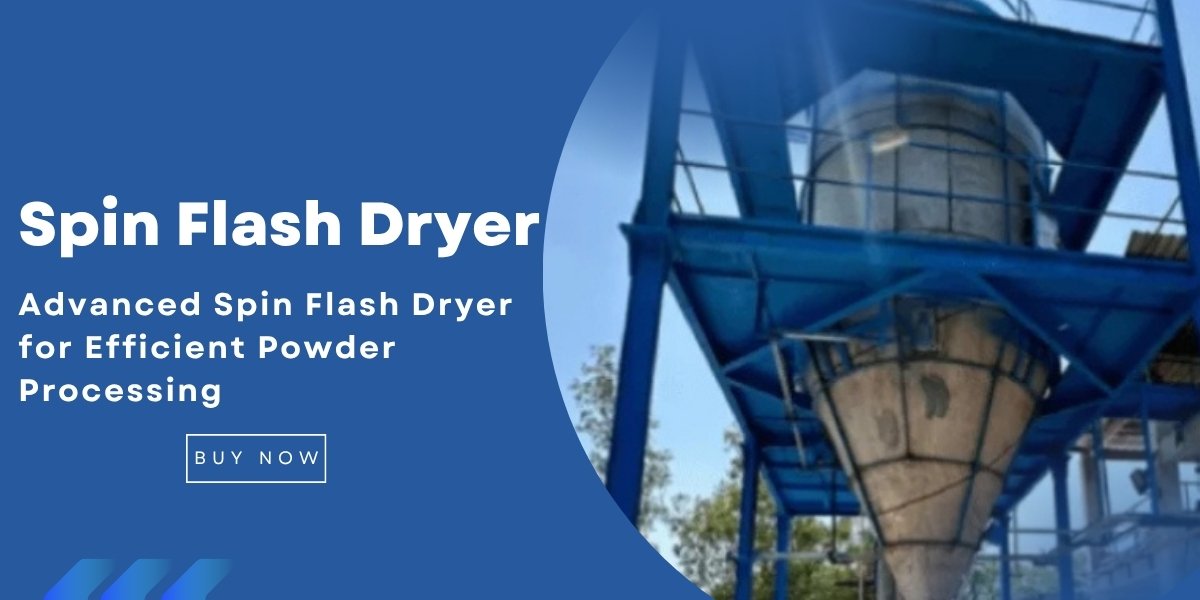
High-Efficiency Spin Flash Dryers: The Ultimate Solution for Drying Viscous Pastes and Filter Cakes
In industrial processing, drying thick pastes, filter cakes, and highly viscous slurries has always been a challenge. Traditional drying methods often result in uneven drying or high energy waste. Enter the Spin Flash Dryer (SFD)—a specialized technology designed for continuous drying of cohesive and non-cohesive pastes.
At RK Engineering (Boilers India), we manufacture world-class Spin Flash Dryers that combine mechanical agitation with thermal engineering to deliver a fine, uniform powder in a single step, proudly serving clients across Kenya, South Africa, Canada, and the United States (USA).
What is a Spin Flash Dryer?
A Spin Flash Dryer is a continuous drying unit that features a vertical drying chamber with a high-speed mechanical agitator (rotor). It is specifically designed to handle materials that are too thick for a spray dryer but too sensitive for a rotary dryer.
The Technical Working Principle
The process is fast, efficient, and highly effective:
-
Feeding: The wet cake or paste is fed into the drying chamber through a screw feeder.
-
Disintegration: The high-speed rotor at the bottom of the chamber breaks down the wet lumps into smaller particles.
-
Drying: Hot air enters the chamber tangentially, creating a powerful “tornado” effect (vortex). This air instantly evaporates the moisture from the disintegrated particles.
-
Classification: An integrated “classifier” at the top ensures that only the fine, dry powder exits the chamber, while heavier, wet particles stay back for further drying.
Send Inquiry
Fill the form and our team will contact you shortly.
Why Choose RK Engineering’s Spin Flash Dryer?
Our systems are engineered to perform in the most demanding environments, from the chemical hubs of Ahmedabad to industrial zones in South Africa and the USA.
1. Continuous, Single-Step Operation
Forget multiple stages of drying and grinding. Our Spin Flash Dryer converts wet cake directly into fine powder, saving you time, space, and labor costs.
2. Thermal Sensitivity Control
Even though the air temperature is high, the “flash” evaporation ensures the product temperature stays low. This makes it perfect for heat-sensitive pigments and organic chemicals.
3. Robust Metallurgy (SS 304/316)
We use high-grade Stainless Steel to ensure your machine is corrosion-resistant and meets GMP standards for pharmaceutical and food applications.
4. Global Compliance
Our equipment is built to meet international safety standards, making us a preferred exporter for clients in Canada, Kenya, and the United States.
Key Applications of Spin Flash Dryers
Where does the Spin Flash Dryer shine? It is the industry standard for:
-
Agrochemicals: Drying of pesticides, fungicides, and herbicides.
-
Pigments & Dyes: Processing of Indigo, Titanium Dioxide, and various organic colors.
-
Food Industry: Handling protein concentrates, starch, and specialized food pastes.
-
Pharmaceuticals: Drying of bulk drug intermediates and cake-form medicines.
-
Inorganic Chemicals: Calcium Carbonate, Kaolin, and Zeolites.
RK Engineering: Your Global Partner for Drying Solutions
Whether you are based in India or operating in Kenya, South Africa, Canada, or the USA, RK Engineering provides end-to-end support.
-
Customized Design: We tailor the rotor speed, feeder type, and air temperature based on your specific material’s moisture content.
-
Energy Efficiency: Our systems are designed to maximize heat transfer, reducing fuel consumption by up to 20% compared to conventional dryers.
-
Export Expertise: We handle international shipping, documentation, and provide remote or on-site commissioning support.
Frequently Asked Questions (FAQs)
Q: Can a Spin Flash Dryer handle sticky materials?
A: Yes. The high-speed agitator is specifically designed to break the surface tension of sticky filter cakes, preventing them from adhering to the chamber walls.
Q: What heating sources can be used?
A: We offer flexible heating options including Indirect/Direct Gas Fired, Oil Fired, Steam Radiators, or Electric Heaters.
Q: How do you control the final particle size?
A: The final fineness is controlled by adjusting the speed of the top classifier and the airflow rate.
