
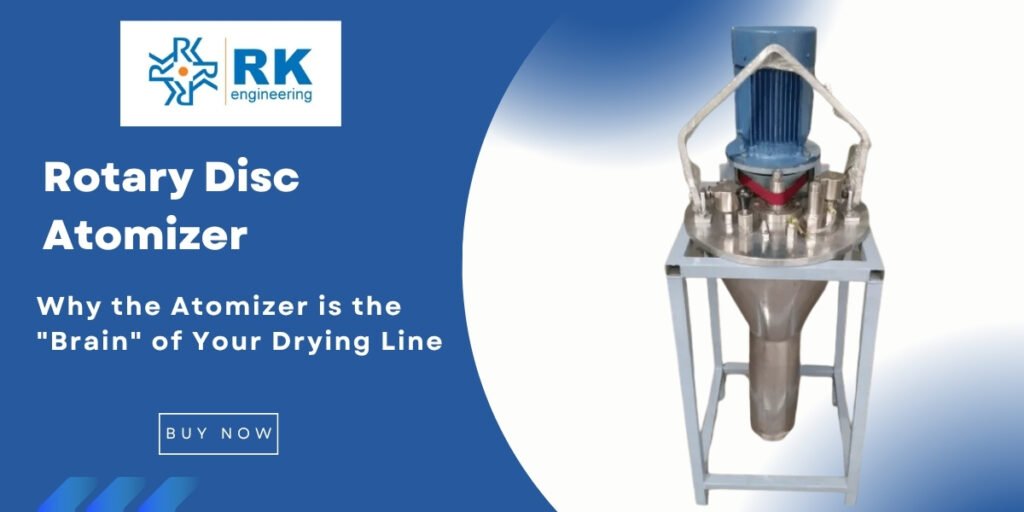
In a high-capacity Spray Dryer, you are essentially turning liquid slurry into a high-value powder. The quality of that powder—its density, solubility, and particle size—is entirely dependent on the Rotary Disc Atomizer.
If your atomizer isn’t perfectly calibrated, you aren’t just wasting slurry; you are creating “fines” (dust) and “oversized particles” that can lead to product rejections and wasted raw material.
Send Inquiry
Fill the form and our team will contact you shortly.
1. How Rotary Atomization Actually Works
The principle is elegant: the feed slurry is introduced at the center of a high-speed rotating disc. Centrifugal force pushes the liquid outward, and as it reaches the edge, it is shredded into millions of tiny, uniform droplets.
The Science of Speed: The droplet size is inversely proportional to the speed of the disc. If you need smaller particles, you increase the RPM. If you need larger particles, you decrease it.
The Critical Challenge: Because these discs spin at extremely high speeds (often several thousand RPM), even a microscopic imbalance can cause vibrations that will eventually destroy your bearings and lead to uneven droplet distribution.
2. Maintenance Tips for High-Speed Atomizers
To keep your production line running without costly, unexpected shutdowns, your maintenance team should focus on three pillars:
Dynamic Balancing: Never assume a disc is balanced just because it looks clean. After every major cleaning or replacement cycle, perform a dynamic balance test. A vibrating atomizer is the #1 cause of bearing failure in spray drying plants.
Feed Distribution: Ensure the slurry is fed directly into the center of the disc. If the feed tube is misaligned, the slurry will “hit” the disc unevenly, leading to erratic droplet trajectories and wall build-up in your Spray Dryer chamber.
Abrasion Resistance: If you are processing abrasive chemicals or mineral-heavy slurries, ensure your disc is coated with specialized wear-resistant materials. A worn-out disc edge cannot create uniform droplets.
3. Integrating with the Complete System
An atomizer doesn’t exist in a vacuum. Its performance is heavily influenced by the upstream and downstream conditions of your system.
Viscosity Control: If your feed viscosity fluctuates, your atomizer motor will struggle to maintain constant RPM. Ensure your pre-treatment stage provides a consistent slurry feed.
Heat Integration: Your Hot Air Generator must provide a consistent temperature to the chamber. If the air temperature drops, the droplets created by the atomizer won’t dry before they hit the chamber walls, leading to the dreaded “wet wall” condition.
Discharge Integrity: The entire drying process is a pressure game. If your Rotary Air Lock Valve is leaking, it will disrupt the vortex inside the chamber, causing the droplets produced by the atomizer to swirl chaotically instead of drying efficiently.
Expert Precision for Your Production Line
If you are struggling to meet your powder quality targets, the issue is rarely the product—it’s usually the atomization. We specialize in high-speed, precision-balanced rotary disc atomizers that are engineered for the rigorous demands of modern chemical and food processing.
Explore our high-performance Rotary Disc Atomizers here—designed with advanced metallurgy for longevity and precise particle size control.
Contact our engineering team if you are seeing inconsistent particle distribution. We can provide a diagnostic audit of your atomization circuit and recommend the specific disc configuration for your material type.
