
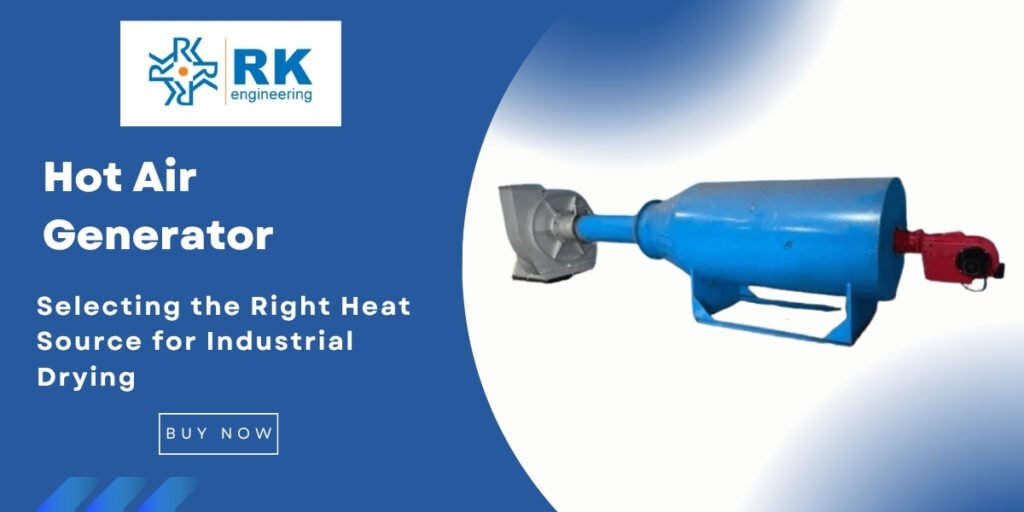
The Hot Air Generator (HAG) is the “engine” of any thermal processing line. Whether you are operating a large-scale Spray Dryer or a high-throughput drying system, the method of heat generation directly impacts your product quality, fuel consumption, and overall operating costs.
The most common debate in industrial heating is: Direct Fired or Indirect Fired? Choosing the wrong one can lead to contaminated end-products or unnecessarily high energy bills.
Send Inquiry
Fill the form and our team will contact you shortly.
1. Direct Fired Hot Air Generators
In a direct fired HAG, the process air comes into direct contact with the burner flame and combustion gases.
The Main Advantage: Extremely high thermal efficiency. Because there is no heat exchanger to act as a barrier, nearly all the energy from the fuel is transferred to the drying air.
Best Use Case: Ideal for processes where combustion by-products (like CO2 or water vapor) do not affect the final product quality. Think of drying minerals, limestone, or specific types of construction materials.
Key Consideration: Because the combustion gases mix with the drying air, this setup is rarely used in food or pharmaceutical industries where purity is paramount.
2. Indirect Fired Hot Air Generators
In an indirect fired HAG, a heat exchanger separates the combustion gases from the drying air. The drying air is heated by passing over or through the heat exchanger surface.
The Main Advantage: Product purity. The drying air remains clean and free from smoke, soot, or combustion residuals.
Best Use Case: Essential for food processing, dairy, fine chemicals, and any application where the material being dried is sensitive to contamination or coloration.
Integration Tip: If you require high-temperature, clean air for sensitive materials, an indirect HAG is often paired with a Thermic Fluid Heater circuit to ensure stable and precise temperature control without the risk of flame contact.
3. Critical Parameters for Sizing Your HAG
Regardless of the type you choose, sizing your generator incorrectly is a recipe for inefficiency. Before finalizing your spec, consider:
Required Mass Flow: How much air do you need to move per hour?
Delta T (Temperature Rise): What is the difference between your ambient air temperature and the required inlet temperature for your dryer?
Fuel Compatibility: Can your burner handle multiple fuels (like biomass, coal, or gas)? Using an FBC Furnace as the combustion source can significantly reduce your fuel costs if you have access to agricultural waste or solid biomass.
4. Why Efficiency Depends on the Whole System
Your HAG does not work in isolation. For instance, if your Rotary Air Lock Valve is leaking, you are essentially “leaking” the expensive hot air your generator worked so hard to create. Maintaining the integrity of your entire system—from the combustion chamber to the final discharge—is the only way to ensure your energy costs stay within budget.
Technical Consultation
Selecting the right heating technology depends on your material’s chemical sensitivity, your energy budget, and your plant’s footprint.
Explore our range of High-Efficiency Hot Air Generators here—we provide both direct and indirect configurations tailored to your specific process requirements.
Contact our engineering team for a thermal load calculation and system design audit. Let us help you determine if your current setup is truly optimized for your production needs.
